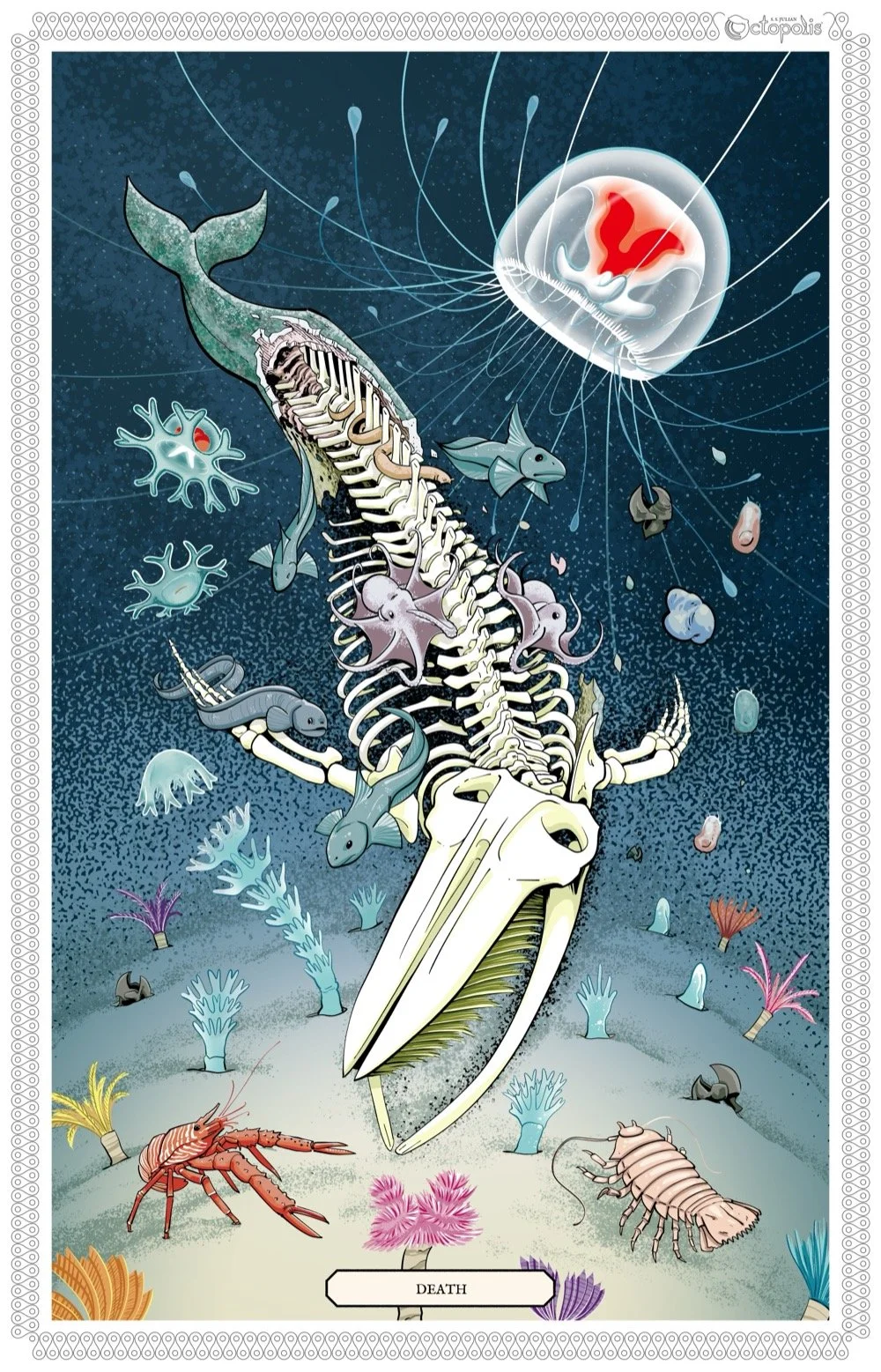
A whale skeleton sinks to the bottom of the sea. It's surrounded by animal life devouring its flesh: fish, eels octopus, squat lobster, isopods, and worms. Around the scene is a representation of an 'immortal' jellyfish life cycle. The adult jellyfish falls apart in 'cysts' falls to the ground and grows anew as a polyp that eventually detaches and becomes a larvae.
Symbolism of Death
The Death card is a representation of the inexorable unavoidable reality of literally, physical death. There’s no avoiding it, the card looks pretty grim.
Le Morte, Marseilles deck.
Death, Smith-Waite deck.
Death, Thoth deck.
Death is an immutable factor governing all existence. All ordered things eventually become unordered, disparate matter. But it’s important that this not be treated as a horror. Death is a natural, necessary part of life. It’s from disordered matter that new life grows, and without Death nothing would change.
So ultimately the esoteric purpose of the Death card is evokes the fundamental transience of form, while also acknowledging the persistence of spirit, or residual legacy that the death of an entity contributes to the future.
Death in Octopolis
You’ll notice all the above depictions of Death display skeletons, but of course octopuses don’t have those. They do have beaks, and I’ve thrown a few of those into the art, but they don’t make quiet the same impact as a full skeleton. So the main focus of this card is, in a first for the Octopolis tarot deck, not an octopus at all but a blue whale.
Life and Death
All complex life on Earth is in ways dependent on the Death. Life could not survive except by consuming from the accretion of earlier Life that preceded it.
In the Ocean, that relationship is even more stark and obvious. Nothing remains unused in the ocean, and abyssal life, life that lives in the unlit desert of the deep ocean trenches, survives only by the grace of the dead and discarded matter that settles down to the ocean floor in the form of marine snow.
This relationship is underscored by the ways whale bodies are reabsorbed by ocean animals. The death of a whale means a multi-day feast for the animals of the ocean floor. Areas that normally appear deserts become congregations for eel pouts, dogfish, hagfish, octopuses, crabs, isopods, worms and more.
The disorganized flesh of the whale is reincorporated into the biomass of other animals, who themselves go off to live, reproduce and die. Thus all of life perpetuates itself in a grand symphony of transition. Death is never the end.
Death as Renewal
As an ethereal counterpart to the beauty of whale decomposition we see depicted around the whale the life cycle of the notorious 'Immortal Jellyfish'. Turritopsis dohrnii is a small hydrozoan (not a true jellyfish) with a normal cycle of sexual reproduction. However, under certain conditions and environmental stressors they can actually revert to an earlier development stage in the life cycle.
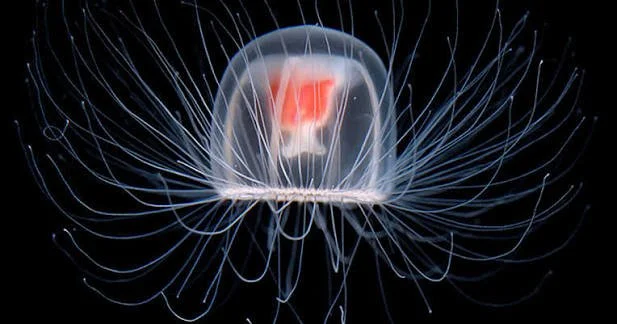
The immortal jellyfish. © Takashi Murai/The New York Times Syndicate/Redux
When its body deteriorates and falls apart, rather than dying it forms little cysts of stem cells that fall to the ocean floor and grow back into the polyp stage, which eventually detach again to grow into full free-swimming medusae. Effectively, clones of their past selves. This process can repeat theoretically indefinitely.
The life cycle of the immortal jellyfish. Source Encyclopedia Britannica.
Genetically they are identical, but would you say the original jellyfish didn't 'die'? I'd argue that it did. It achieved a fundamental transition in form, even if it retains a precise legacy of its past. The immortal jellyfish is a symbol of the transcendence of continuity that perpetuates through and beyond death. Everything we do has an impact of the world, and will continue to do so even after we're gone, like the ripple of a wave.
Artist’s Notes
The whale skeleton is based on a blue whale. Skeletons are hard to draw, so I am grateful to the Natural History Museum of London for making a 3D model of theirs available free for use. You can take a look at it here.
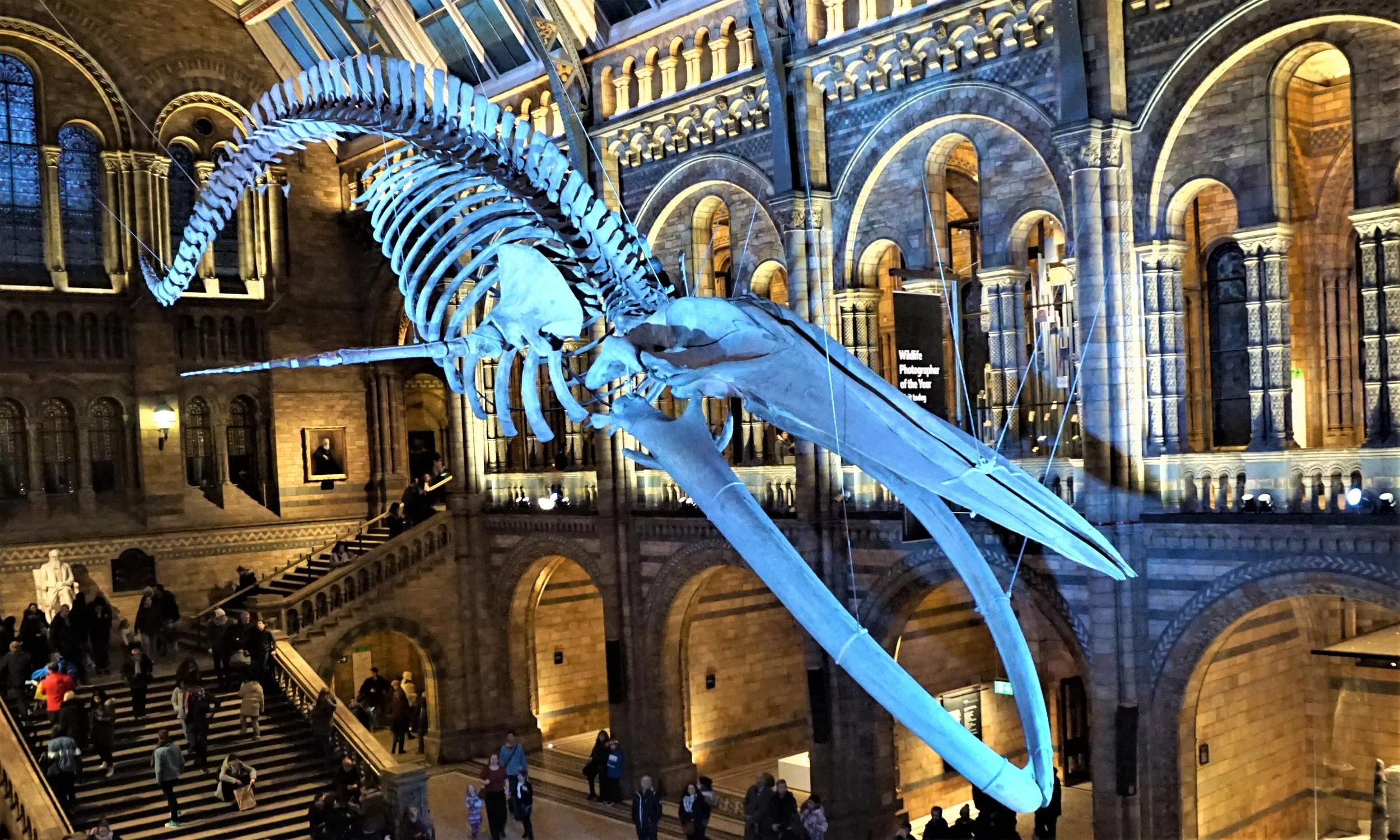
“Hope,” the blue whale skeleton on display at the Natural History Museum of London.