Fortune
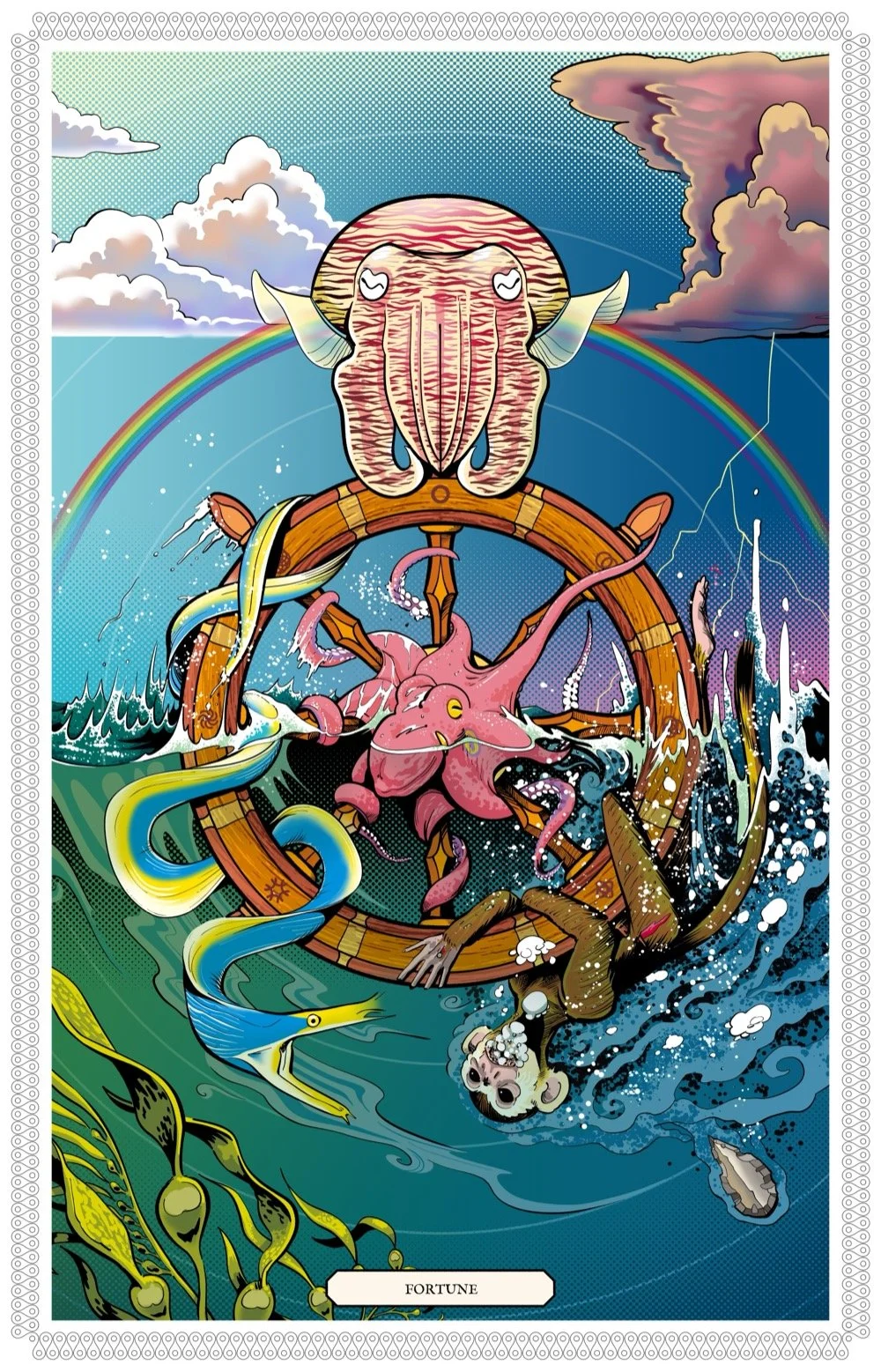
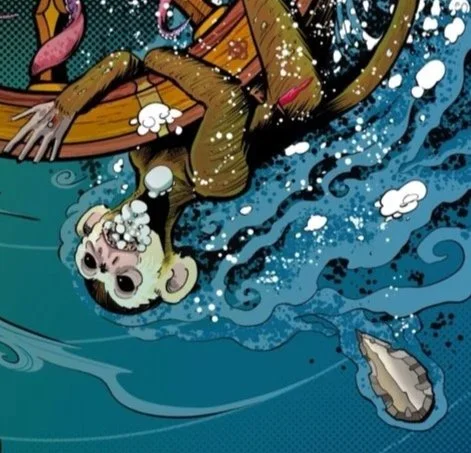
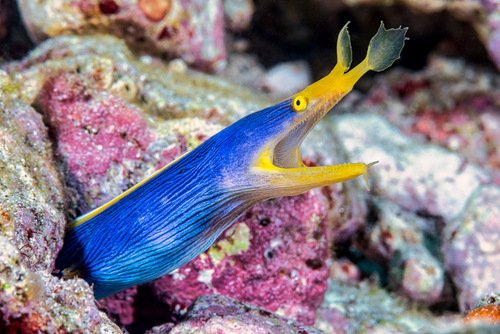
A ship's wheel spins, crashing through the surface of an ocean. At its center, an octopus struggles to grip a handle. A monkey skewered to the descending portion loses consciousness as it is submerged, as a ribbon eel gapes as it’s drawn upward from the other end. Atop the wheel a pharaoh cuttlefish hovers impossibly, inscrutable. A rainbow arcs across the sky, as the weather turns.
Symbolism
Fortune, or the Wheel of Fortune as it was originally called, has always been about the caprice of Fate: You never know what tomorrow will bring. Sometimes you're on top of the world and sometimes you're being crushed underneath the weight of it all. We mere mortals may not be able to control or influence it all, but there is some comfort in the balance of revolution, and that "what goes around comes around." Things could be better but they might get worse took, so appreciate what you have and live in the moment!
The concept evokes syncretic associations with the Indian bhavachakra (Wheel of Becoming), the celestial rotation of the Zodiac, and the sanskrit cycle of change known as Samsara. Historically it has been invoked to justify hierarchies and revolutions in equal measure, and was already considered a cliché by the early Roman period.
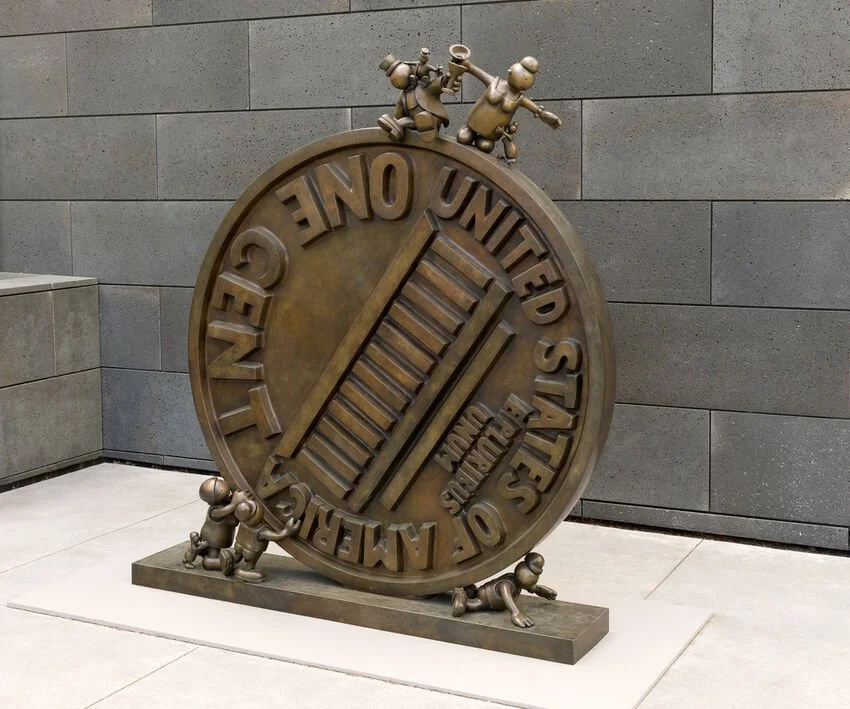
Big Big Penny by Tom Otterness, 1993
La Rove de Fortune, Marseilles deck.
Past depictions of fortune populate the wheel with animal figures pregnant with symbolism.
The original Marseilles deck had animals (whether they're monkeys, donkeys or dogs who can tell) all in regalia evocative of their position on the wheel. It's clear the winged monkey on the top has a crown and a sword and feels pretty satisfied with itself. The descending beast looks to be wrapped in a barrel skirt, definitely unhappy to be there. The animal on the right seems to be running up the wheel with a determined look on its face. Based on the armor they're wearing they're probably prepping to unseat the self-satisfied monarch up top. I read this as a pretty straightforward commentary on power and socioeconomic dynamics.
Wheel of Fortune, Smith-Waite deck.
The Smith-Waite deck went all out packing the card with esoteric symbolism. The three figures have been converted to a sphinx, snake and some kind of jackal-man, which don't lend themselves as easily to the social hierarchy readings. They also pack in not only the four Tetramorphs (Clockwise from the top we have Matthew/Aquarius, John/Scorpio, Mark/Leo and Luke/Taurus) but also the four alchemical symbols of Mercury, Sulphur, Water, and Salt, the Hebrew Tetragrammaton (Yod, Heh, Vau, Heh), and even a bit of a pun: the letters TARO can be spelled to be TARO (Tarot), ROTA (Wheel), or even TORA (Law). Smith really went all out with this one, and far be it from me to criticize the masters but to me it feels a bit overstuffed. When you include everything there's less focus, and we already have The Universe.
Fortune, Thoth deck.
Even Crowley couldn't outdo that potpourri of prophecy and actually tones it down a bit (a true rarity for the Thoth deck). This version does away with the periphery with a lightning storm vortex, and leans into the three OG figures. Drawing in Egyptian mythos more directly, they've kept the Sphinx, turning the jackal into a monkey, and the snake into a kind of crocodile monster. There are a number of different concepts each of these are intended to invoke across various traditions (Qabala, Hinduism)
I go into all this detail because it's interesting but also it shows the wealth of choices one has to consider when designing a Wheel of Fortune card. So with that, I will talk about the choices I made for the Fortune of Octopolis.
The Fortunes of Octopolis and Humanity
For my card I've focused on the three figures of the wheel, plus a new, central figure.
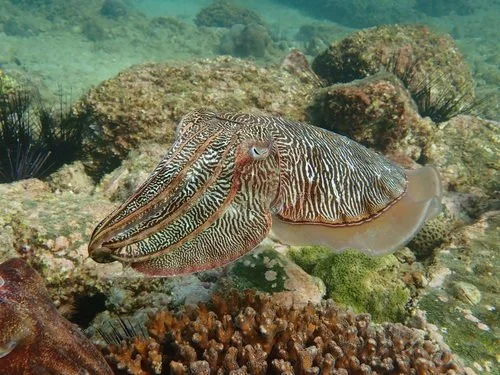
At the very top, serene and regal we have the pharaoh cuttlefish. This is a real species of cuttlefish, and I am convinced it got that name because the horizontal banding gives their arms the resemblance of the sphinx's headdress. The cuttlefish makes for a good sphinx analogue: their labyrinthine patterns can hypnotize prey, and their porous cuttlebone gives them excellent buoyancy control. Like the sphinx, they hover balanced atop the Wheel, inscrutably observing. They may not have a sword, but their tentacles are always ready to snap out at vulnerable prey.
We’ve seen the monkey before, in The Alchemist. They weren’t doing so well there and indeed, our monkey avatar has undergone a reversal of fortunes since the Smith-Waite and Thoth decks. This one's on the way down, below the surf and suffering for it. This reflects the state of primate prospects in the context of Octopolis: homo sapiens is extinct, and there's a new octopedal dominant species on the planet.
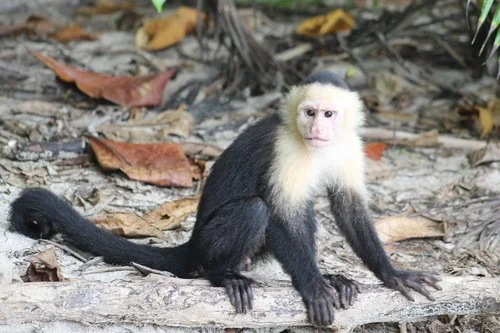
Capuchin monkey, photo by Ivany Argueta
Eagle-eyed observers will note that the monkey is nailed and skewered by the wheel itself. The stone adze in the bottom left has dropped and is sinking to the bottom of the sea, representing the ape's loss of technological knowledge due to extinction. Who will pick it up, I wonder?
The ribbon eel is on the way up, it seems, but not by any act of its own. It's just tangled in the wheel. As we’ve previously noted, Eels are the mythical adversaries of the octopus, as dragons are to humans. In the world of Octopolis, they’ve been domesticated and defanged, present and populous but subordinate to their cephalopod overlords. Reptiles have had their day, after all, 65 million years ago. Perhaps they will again, but the overall message of the Wheel here is that none of these animals have direct control over their fortunes.
Of course, our friend in the center didn't get that message. Alone among the animals on the wheel, the octopus is in the center, dealing with the crush of surf constantly. Its arms are wrapped around each spoke of the wheel, and one even reaches out for the handle, as if by grabbing that it could somehow turn the tide of fate. And perhaps they can; after all, octopuses are our protagonists in this morality play. But even if they could get a grip, how would they find the leverage to steer the ship?
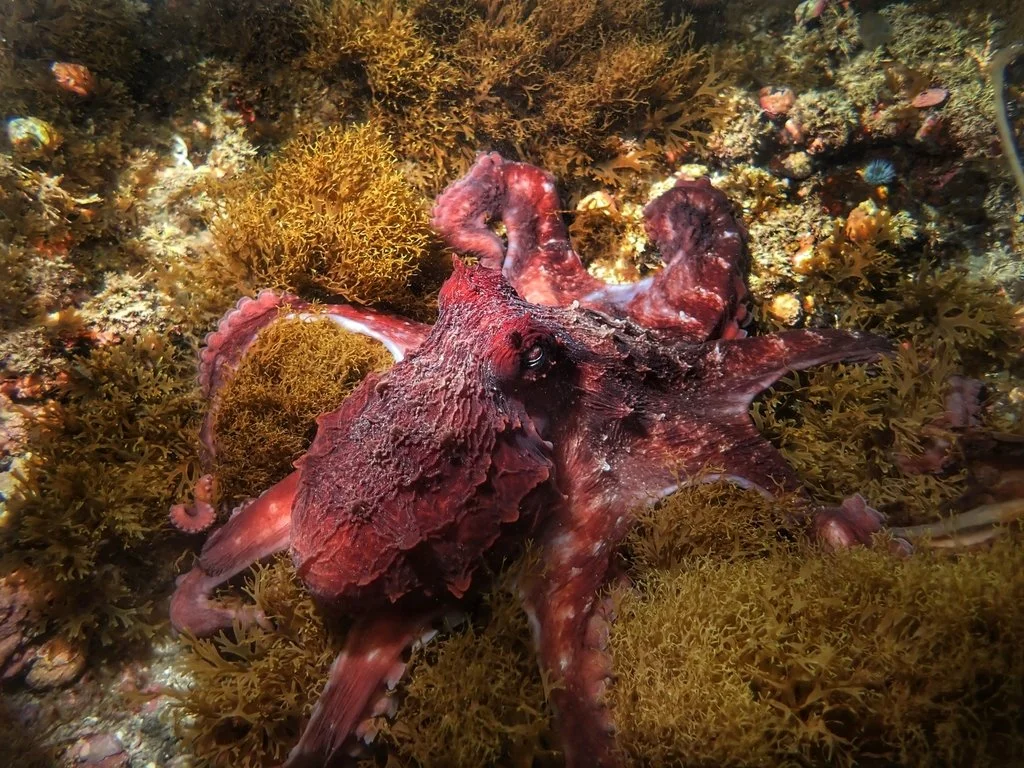
Southern red octopus, photo by Daniel Fernando Vidal
One symbolic innovation that I’m proud of here is that I’ve placed the wheel half in and half out of the water. The monkey is being dunked, which is bad new for him. But the situation doesn’t look any better for the eel, who can’t survive out of water any better. Fortunes can change for everyone, but everyone’s idea of good and bad fortune aren’t the same, either!
Artist’s Notes
Original sketch of Fortune
I almost did the Tetramorph. I really did. I have corresponding animals picked out for them already and everything, (John’s a cormorant!) but ultimately this card was already busy enough, with symbolism and detail. We'll get to see them later, anyways.
I did include symbolic representations of them, however, in the environment. The sunny clouds are Air (or in Octopolis, Gas), the rainstorm is Water, the adze is Earth, and the kelp is Fire. Kelp isn't fiery, you shout! But it is, in Octopolis, because octopuses don't have fire! So instead Fire is replaced by Bloom, the energy of the upwell, and Life itself. These elemental associations map to each of the four Tarot suits, and each of the four tetramorphs (Matthew, John, Luke and Mark, resepctively).
They style of this card feels more 'comic-book' than previous cards, and I think it's because of the split focus. There isn't a unified figure, so all get depicted more or less representationally. This seems appropriate to me, the animals are all symbols, not specific individuals. If anything they could be less representational and more iconic.