The Hermit
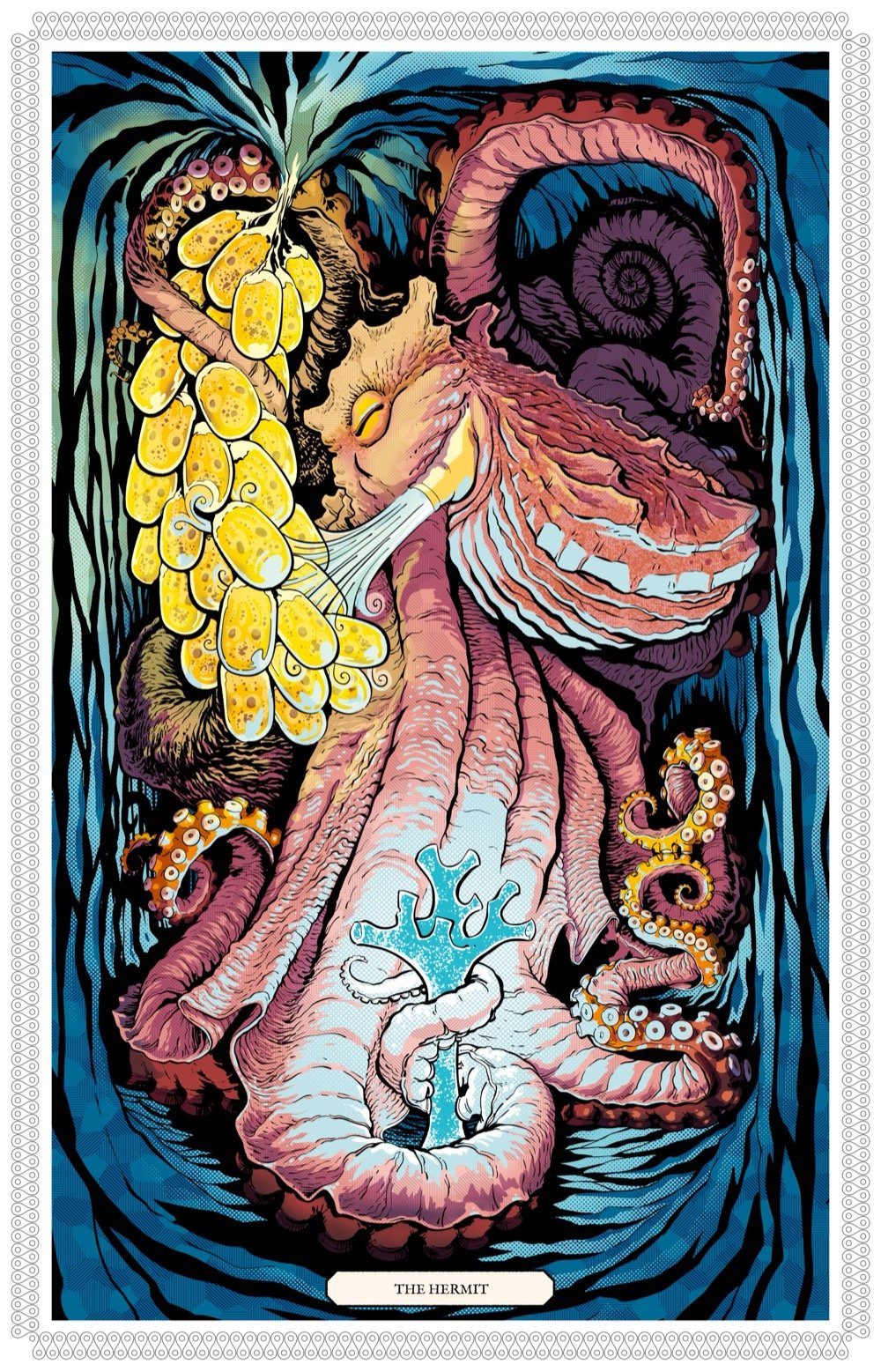
An octopus sits ensconced in a dark blue cave, curled up against the surfaces and walls. She cradles a clutch of golden eggs, and blows air through them with her funnel. She holds a branch of bioluminescent coral in one arm, while her other arms commune with themselves, each other, or her eggs.
Symbolism of The Hermit
The surface interpretation of The Hermit is of solitude and introversion, but more specfically it’s about isolation with purpose. Hermitage is a mechanism for reflection, contemplation, and self-discovery. Periods of self-imposed isolation can lead to epiphanies, greater understanding of oneself and one’s relation to the world. At a deeper level, The Hermit is about the product of this journey of self-discovery. Despite the traditional depiction of the Hermit as a bearded old man, scholars of the Tarot consider the card to represent Fertility in its deepest sense: the gestation of the self.
L’Hermite, Marseilles deck.
The Hermit, Smith-Waite deck.
The Hermit, Thoth deck.
The Hermit of Octopolis
I’ve chosen to represent the Hermit not as an old man but as a brooding female octopus. Octopuses are notorious for their terminal reproductive cycle: towards the end of her life the female will lay her entire clutch of eggs in a den, never to leave. She spends the rest of her life protecting these eggs: keeping them clean from harmful growth, aerating them with oxygenated water flow, and driving off opportunistic predators that might make a meal of them.
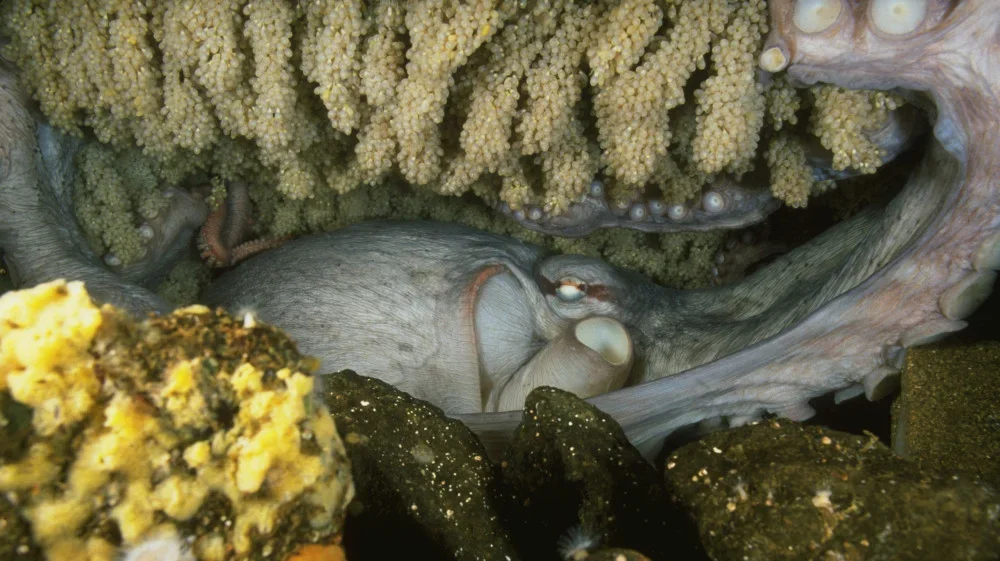
A brooding octopus. Photo by Stuart Westmorland.
In real life, this marks the end of the female octopus’s life, but in the world of Octopolis the species has escaped from their evolutionary oubliette (see, The Third Spear). So our Hermit retains a sense of herself that will be reborn from this, a vision of themselves continuing into the future. The symbol of this is a literal lantern: the bioluminescent coral she holds, which ‘spawns’ light into the darkness of the cave. This is the “male” aspect of the card that completes the metaphorical cycle of synthesis.
Mesa Schumacher; Source: “Multiple Nerve Cords Connect the Arms of Octopuses, Providing Alternative Paths for Inter-Arm Signaling,” by Adam Kuuspalu et al.
As our Hermit nestles in her isolation and broods upon her creation, her arms occupy themselves in various aspects of hermitage. Some engage with the eggs (left); Octopus eggs are transparent and the babies can perceive stimuli through the membrane during incubation. Some diminish into spirals of self-analysis (top right), and otherws engage in communion with one another (bottom right). Octopus arms are semi-independent and have neuronal connections independent of the central brain.
In this way, octopus anatomy contains a physical representation of the ways in which self-dialogue can facilitate the further discovery of one’s inner self.
Artist’s Note
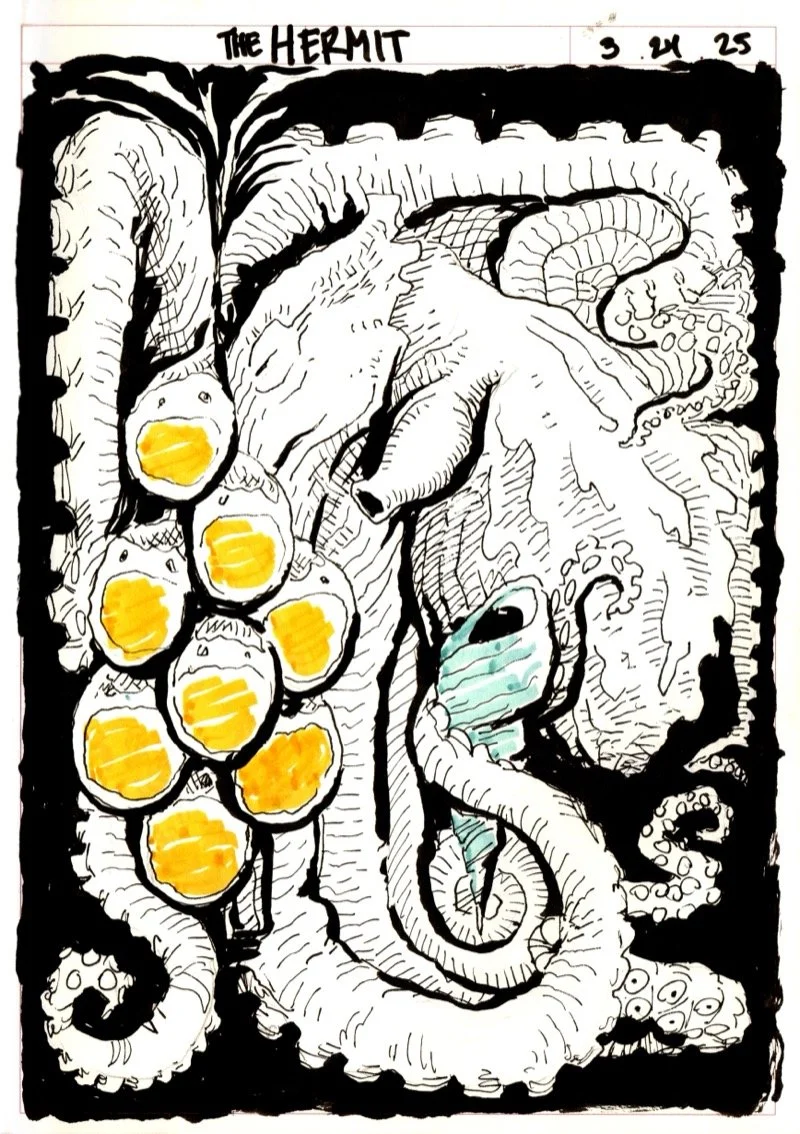
Original sketch of The Hermit
I drew the initial sketch for The Hermit over a year before I actually did the final piece, it’s one of the few where the concept sprung full into my mind almost from the get-go.
I began the final drawing not long after SDCC 2026, on the plane to Spain to watch the total solar eclipse. It may be funny to think of traveling the world as the behavior of a Hermit, but I was genuinely thinking of the trip as an opportunity to focus on myself and my family away from our normal lives, and commune with nature (astronomical events).
During the trip it became the one bit of ‘work’ I could pick up and put down in the spare moments I had, and thus it began to adopt the recursive, fractal details present in the individual folds of skin. I liked incorporating lots of little texturews, it calls to mind the cracks and crevices of caves, of aged individuals, of the hidden truths waiting to be discovered in the details. I also drew on patterning I observed in Barcelona, the walls of the cave and the octopus’s skin are inspired by the walls of Gaudí’s Casa Batllo, which are themselves inspired by the polyps of hard coral.
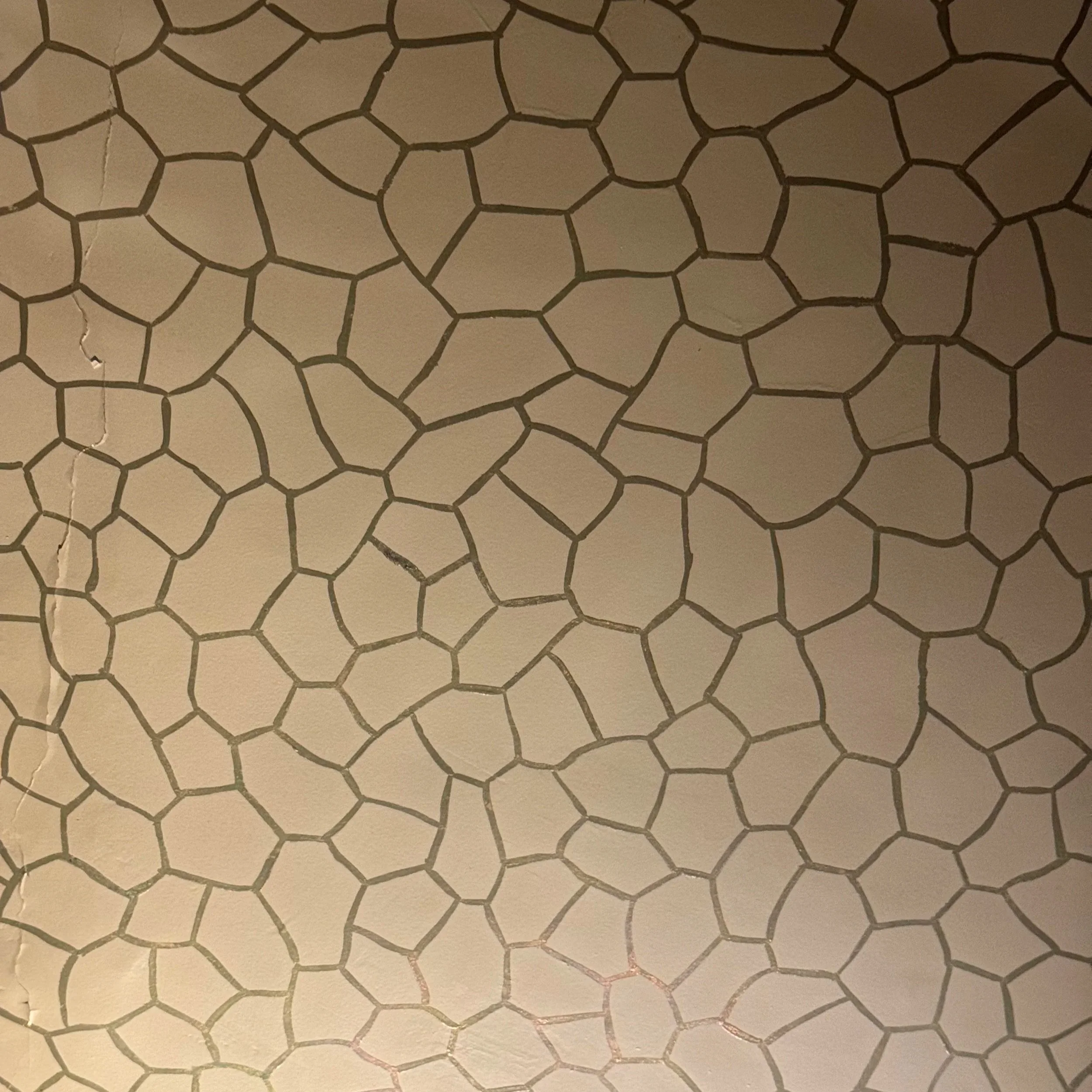
Hand-painted wall patterns in Casa Batllo
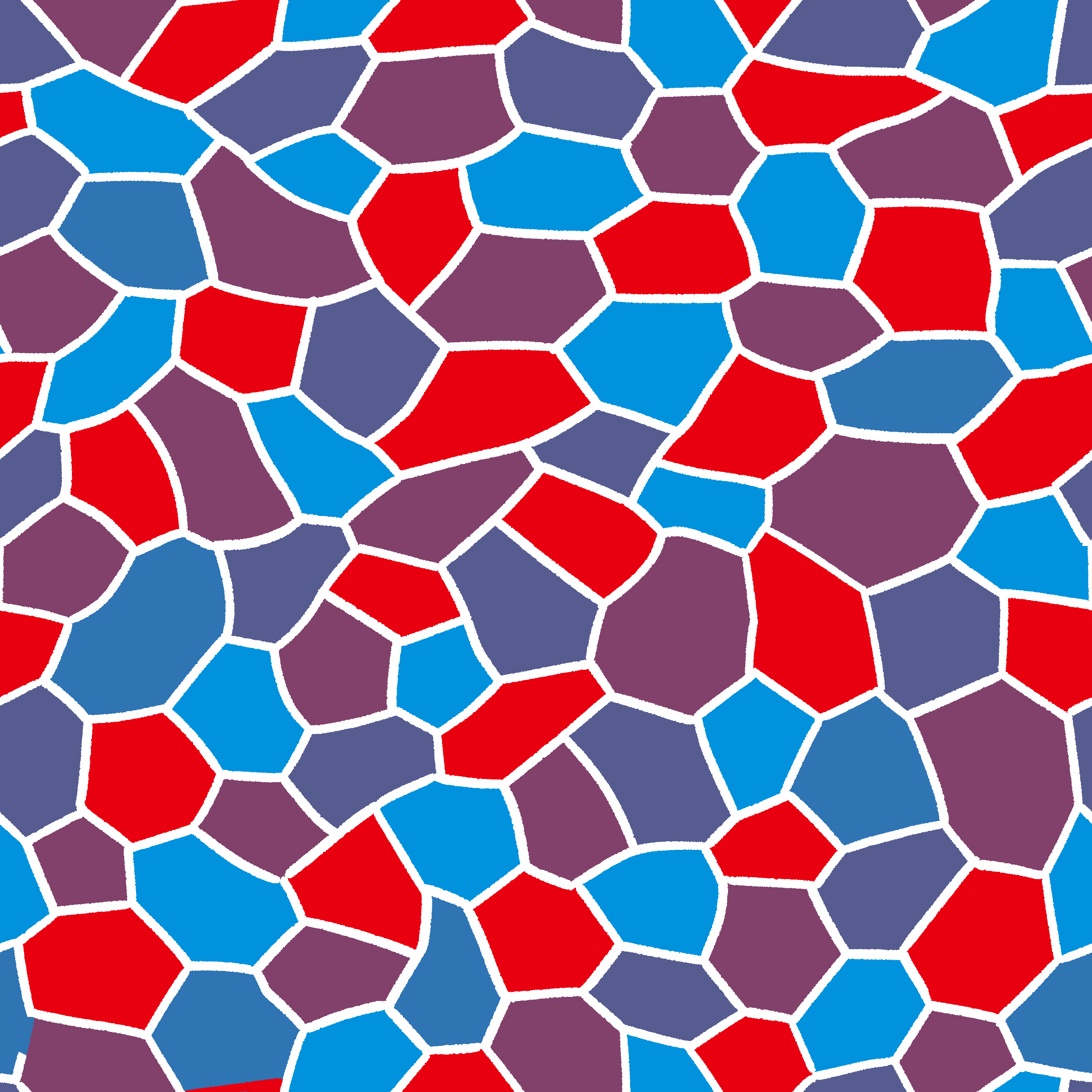
The digital pattern I created to emulate it.
Little did I know, the world was about to impose on me a period of literal isolation: immediately after getting home from our trip I tested positive for Covid-19 and also an additional simultaneous virus. Final completion of the card was delayed for another week, as my body processed the fatigue and fever of a foreign body. Like The Oracle, this was a piece where I kept adding details and had trouble deciding when it was ‘done’. I was worried all the overlapping textures would start to become disruptive and lead to more interference than transcendence. But when I got there, I knew it.
Ultimately it stands as an example of some of my best work: The Hermit, a product of my own physical and spiritual hermitage.