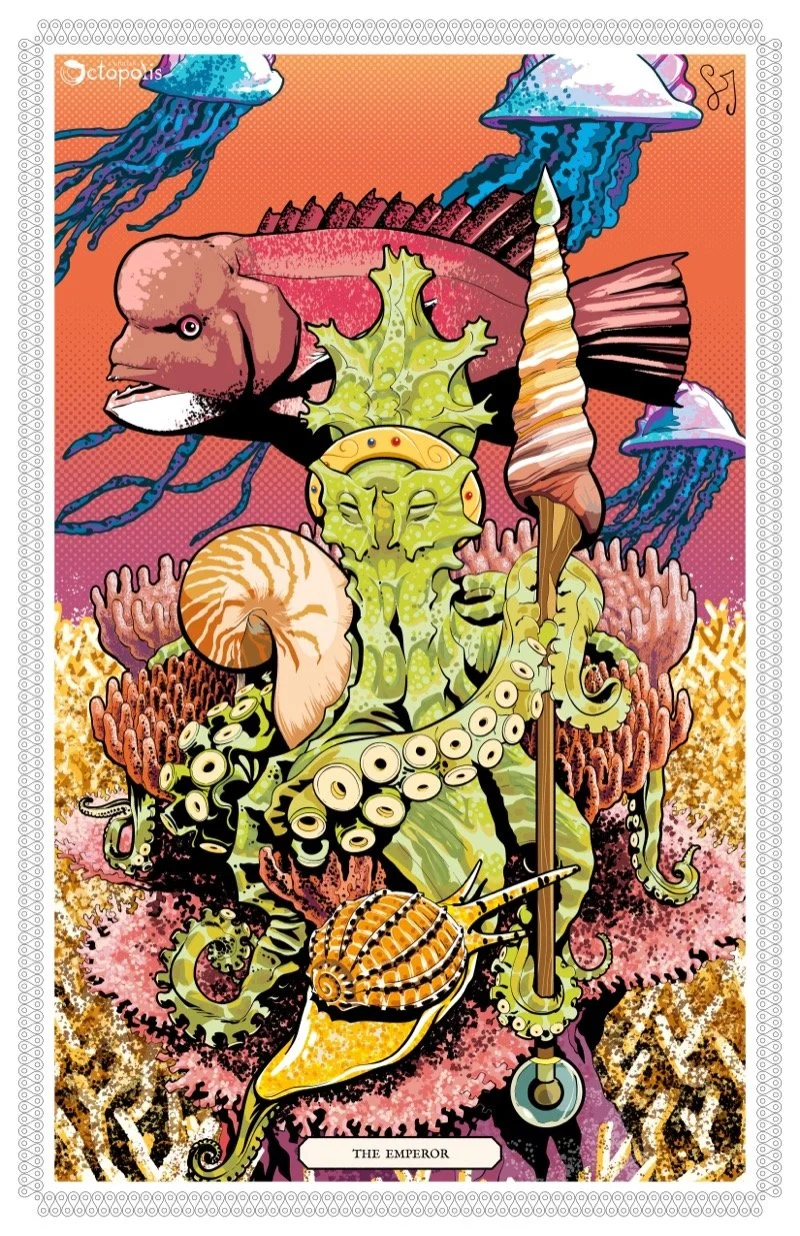
The Emperor stands erect on a terraced throne of staghorn coral. He wears a bejeweled crown ring around his spiked mantle, and wields a turitella shell spear. A large nautilus shell covers his third right arm, and a harp snail envelops his forearm. Swimming behind him is a male sheepshead wrasse, along with a school of inflated man-o-war siphonophores.
Symbolism of The Emperor
The Empress traditionally represents fundamental masculine power. Similar to The Empress, his expression is enigmatic and inscrutable. His posture is martial, he is wearing armor, and usually he is depicted as old. Symbols of virility abound in depictions of the Emperor.
The Emperor is often considered synonymous with the ‘Land’ but the source of his power is through sacrifice. Ultimately, the King must die for his Kingdom, in both a metaphorical and literal sense.
L’Empereur, Marseilles deck.
The Emperor, Smith-Waite deck.
The Emperor, Thoth deck.
The Emperor of Octopolis
This drawing is filled with phallic symbolism. In the same way that the Emperor is flanked by ram horns in the traditional Emperor card, I have surrounded the Octopolis emperor with shells of all kinds.
The mollusk shells are of course bulbous and hard.
The harp snail is one of the meatiest-looking sea snails out there. They’re truly enormous when they extend out of their shell to go nocturnal hunting.
The man-o-war siphonophores are colonies of animals that float on the surface of the water by inflating themselves with gas. Their ‘tentacles’ are thousands of polyps, each with stinging cells shaped like little hooks.
The staghorn coral is hard and pointed. It reflects the male member and is also uncomfortable to sit on.
The male sheepshead wrasse is an incredibly territorial animal with a huge bulbous forehead and sharp teeth for ripping bites.
The Emperor has very large, almost comically large suckers at the base of the web. This reflects real male octopus phenotypes in the wild.
Masculinity in the Octopolis Matriarchy
I wanted the Emperor to represent masculine energy in much the same way as the Empress, but filtered through the unique biology and culture of Octopolis. The dominant cultures in Octopolis are matriarchies, and even high ranking males wear symbolic taboos reflecting their societal role. The “crown” is actually a ring, constricting mantle inflation. The nautilus shell worn on the third right arm is another restrictive marker of gender: it serves to hide the hectocotylus sex organ found on the third-right arm of male octopuses. For this reason I think the shelled mollusc would probably be one of the most symbolically phallic animals in octopus culture.
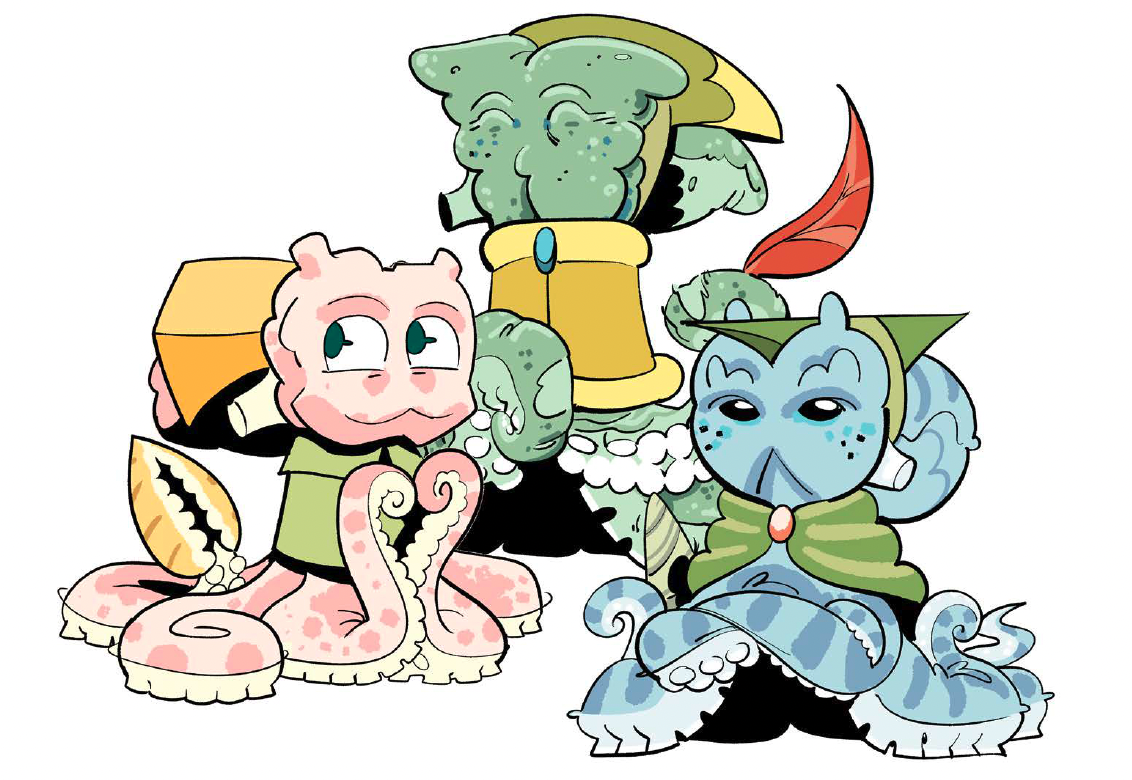
Kurita’s three dads all wear ‘hats’, restrictive bindings around the base of the mantle, and shells over their third right arms. These are cultural taboos that serve as external markers of their gender.
Ocean Sex is “Fluid”
The sheepshead wrasse is the perfect encapsulation of male power in Octopolis. If you've ever interacted with a sheepshead, you know how aggressive they are. With their giant hump and bright coloring they're quite distinctive compared to their more numerous female counterparts.
So while they seem to be emblematic of a harem-style patriarchal culture, in fact all sheepshead wrasse are born female. It's only when territory becomes available that a dominant female will undergo a chemical sex change and become the male representative of a given population. So while these bulbous aggressive fish exude the trappings of masculinity, ultimately their power is derived from the female.
A California sheepshead wrasse. Photo by Marty Snyderman.
An asian sheepshead wrasse. Photo by Totti.
Artistic Process
This card is meant to be a diptych with The Empress. The two can be placed side-by-side and the background matches closely.
Reflections on The Emperor
The Emperor of Octopolis may seem powerful, but he's old and weak. So he surrounds himself with conspicuous symbols of virility, and displays inordinate aggression to avoid a direct challenge to his authority.
This is actually a documented behavior in the wild; old dominant male ungulates will put a higher proportion of calories into their antlers as they get older, even at the expense of their deteriorating health. In evolutionary behavioral biology this is referred to as a ‘terminal investment’.
As in human culture, the patriarch of Octopolis is the symbolic lead warrior of his community. But as the tip of the spear or an autotomized arm, they are also the part of the body that will be sacrificed in times of conflict. (While Frazer’s The Golden Bough has largely been discredited as a serious work of anthropology, its reflections on the mythologies of the Corn King and our collective understanding of the King as an avatar of fertility remains influential).
I think a lot of people, especially these days, want to embody the Emperor without adopting any of the responsibilities inherent to the role. If you want to be the King, you have to be willing to sacrifice yourself.