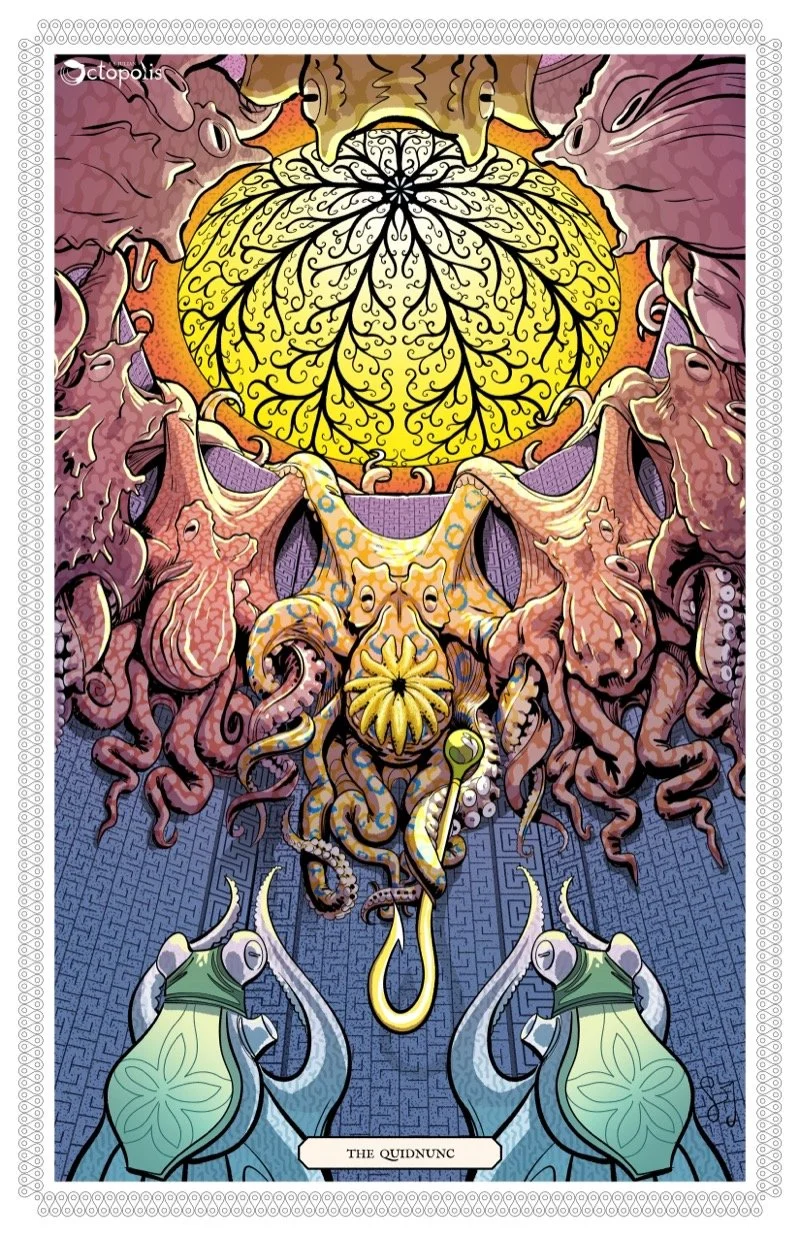
The Quidnunc looms imperiously over two deferential suppliants. One of their number, distinguished by the crown of thorns seastar clasping its mantle, extends an arm wielding an ornate staff carved into a hook. The scene is illuminated by light filtered through a dome, filigreed with the preserved endoskeleton of a basket star.
Symbolism of The Hierophant
The card is traditionally represented by The Pope, a single entity who acts as the head of the church. More modern versions use a more generic term of ‘hierophant’ to encompass a supreme authority figure in a religious or otherwise dogmatic sphere of influence. They’re always represented gilded in symbols of their structural power, and in the act of executing that power.
Le Pape, Marseilles deck.
The Hierophant, Smith-Waite deck.
The Hierophant, Thoth deck.
The Quidnunc of Octopolis
The Quidnunc is Octopolis's analogue to the Pope, or Hierophant. Octopolis does not have a hierarchically organized church, at least not within the cultures I've chosen to explore so far. Their religion is more animistic and individual, led by charismatic shamanic leaders like The Oracle.
Another consideration: up to now I've drawn a lot of powerful individuals, and so I wanted to distinguish this card in a way that viscerally emphasized the difference in the kind of power wielded by religious/cultural institutions, as opposed to the individual power wielded by a military or political leader like the Emperor or Empress. The authority of a Hierophant is derived from their invocation of their organization, so their power resides more in their dogma’s overall structure than in the uniqueness of the individual wielding it at any given moment.
So, I have chosen to represent that power as The Quidnunc, a Council of Eight that governs the citystate of Polyps. These are eight individuals, each acting as representatives of deeper entrenched aristocratic power, who preside over serious civil matters and issue decrees as a collective.
They use color, touch and chemical communications to confer silently amongst themselves before passing judgment. The 64 arms of the eight pontifices interweave, forming a nonverbal network as they dispense their collective dogma upon their domain. Patterns ripple across this ring of interlocked sucker and muscle, nearly impossible to distinguish one individual from another.
To me this kind of collective framework of power more accurately reflects the way cultural dogmas exert power over communities and individuals, especially in the modern era. Perhaps in the age of the renaissance the Hierophant was a charismatic individual, with a private army and hierarchical civil power, but today the power of religion is more abstract deeply embedded into the fabric of society. It's not a hereditary power like an aristocracy; the individuals that wield it do so by invoking a shared cultural network, a sense of norms that has seeped into the collective unconscious of a society. An individual can impose the will of the Hierophant without resort to brute coercive force. They need only define the boundaries separating in-group from out-group, and the mesh of social cohesion will do the rest. The Quidnunc is the avatar of that gatekeeping force, that judges whether you are brought into the fold or excommunicated.
What’s a Quidnunc?
The term 'quidnunc' is an archaic term for an inquisitive or gossipy person. However, I am using it in reference to usage coined by David Scheel in his book 'Many Things Under a Rock', in which he describes a particular pattern of behavior seen in octopuses living in the real-life sites of Octopolis and Octlantis. At times in these ad-hoc octopus 'communities' a single larger male will takes on a 'role' of the Quidnunc.
“The Quidnunc seldom occupies a den when there are several other octopuses around, and rarely leaves the site, but spends the day crossing and recrossing the shell bed to check and vet each octopus that comes or goes or draws his attention. He is the only octopus who routinely visits dens just after another octopus has left them, feeling inside the empty space briefly before returning to coursing back and forth. This octopus does not behave like the others—not like the females—and if there are other males about, they do not behave like this male, either.”
- David Scheel, Many Things Under a Rock
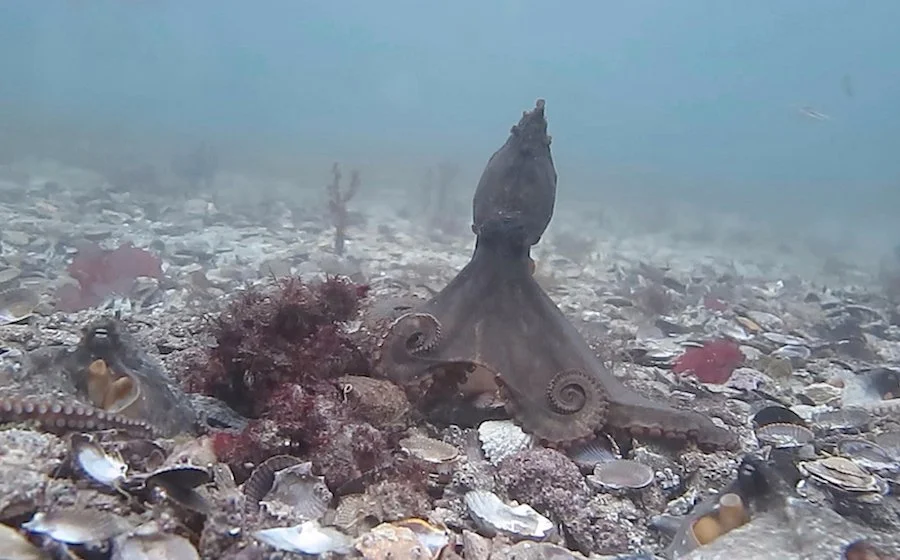
Octopus tetricus in Octopolis or Octlantis. Photo by Peter Godfrey Smith.
Rather than occupying a den, the Quidnunc spends the day pacing the shell bed to check each octopus that comes and goes or draws his attention. He will routinely visit recently abandoned dens, confronts newcomers, and 'involves himself with others at every opportunity'. They operate with 'bluster and threat that when necessary may be backed by physical force'.
To me this Quidnunc seemed like the first formal instance of an octopus enforcing 'rules' of any kind on the collective, notably rules moderating behavior, rather than direct control of resources. I recognize I’m anthropomorphizing observed behavior, but that’s my whole exercise in creating Octopolis. Imagining the formalization and sophistication of this emergent role over time led to my construction of the Polypian Quidnunc as a political entity in Octopolis.
Symbolism in the Details
I debated whether distinguishing one of the Quidnunc from any of the others— in Octopolis I don’t think of any one of them having executive authority over the others. But I wanted to introduce more symbolic elements, and so I decided to make the central one the ‘Speaker’ for the purposes of the card.
The Speaker is a blue-ringed octopus. These are a highly venomous octopus species, and in the world of Octopus, they are the inspiration for one of the primary aristocratic Dens (ruling families) of Polyps.
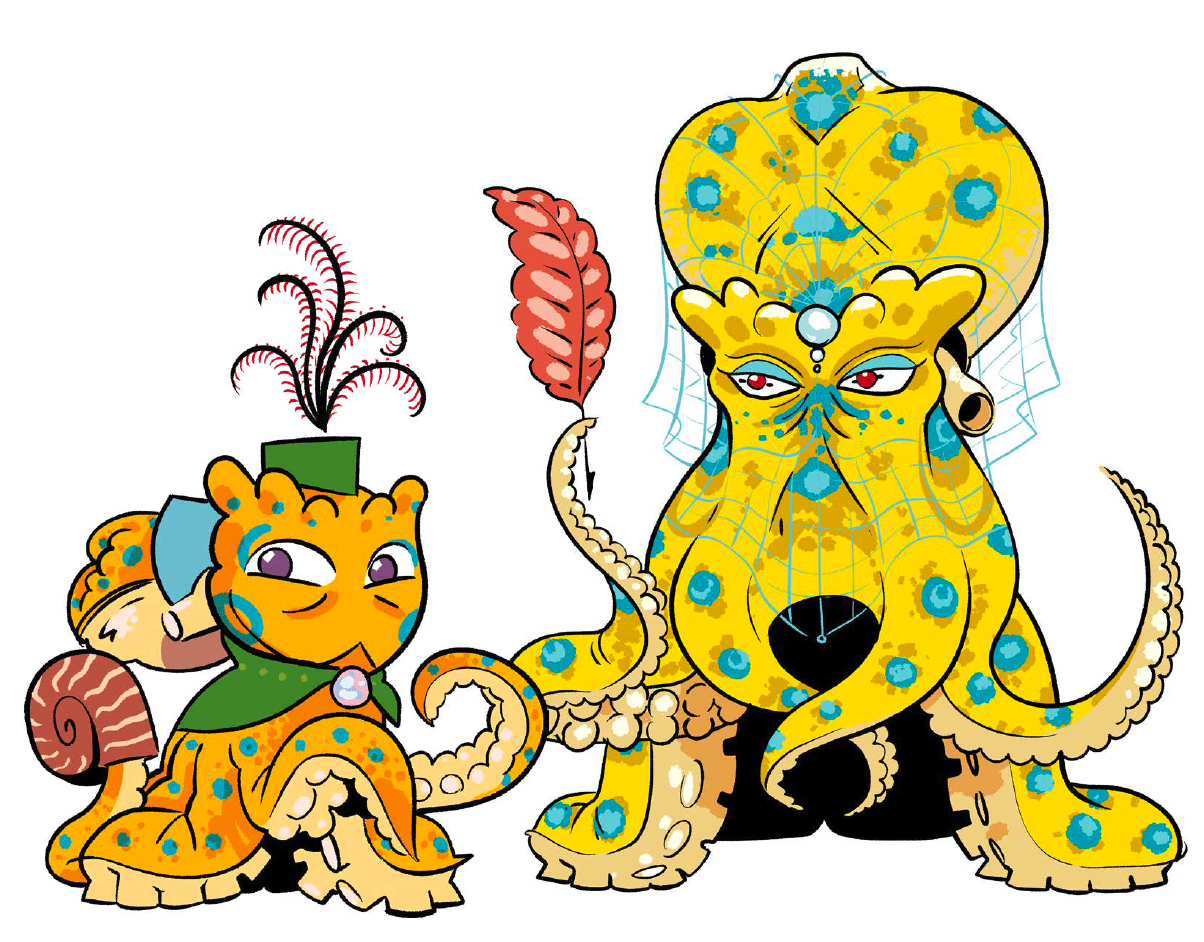
Members of the venerable and wealthy Maculosa Den of Polyps.

Sunflower sea star. Photo by Erin McKittrick
The speaker is wearing a sunflower sea star as a ‘hat’. Sunflower stars are voracious predatory carnivores, lack a central brain, and, if divided in half, can regenerate into two distinct wholes. If there’s a better metaphor for organized religion than a ‘sunflower sea star’ I haven’t found it.
The hook the speaker wields is a nautical inversion of the shepherd's crook. Too often representatives of dogma take it upon themselves to become 'fishers of men' without respect for the will of the men in question. In the eyes of the Hierophant, control and protection become conflated.
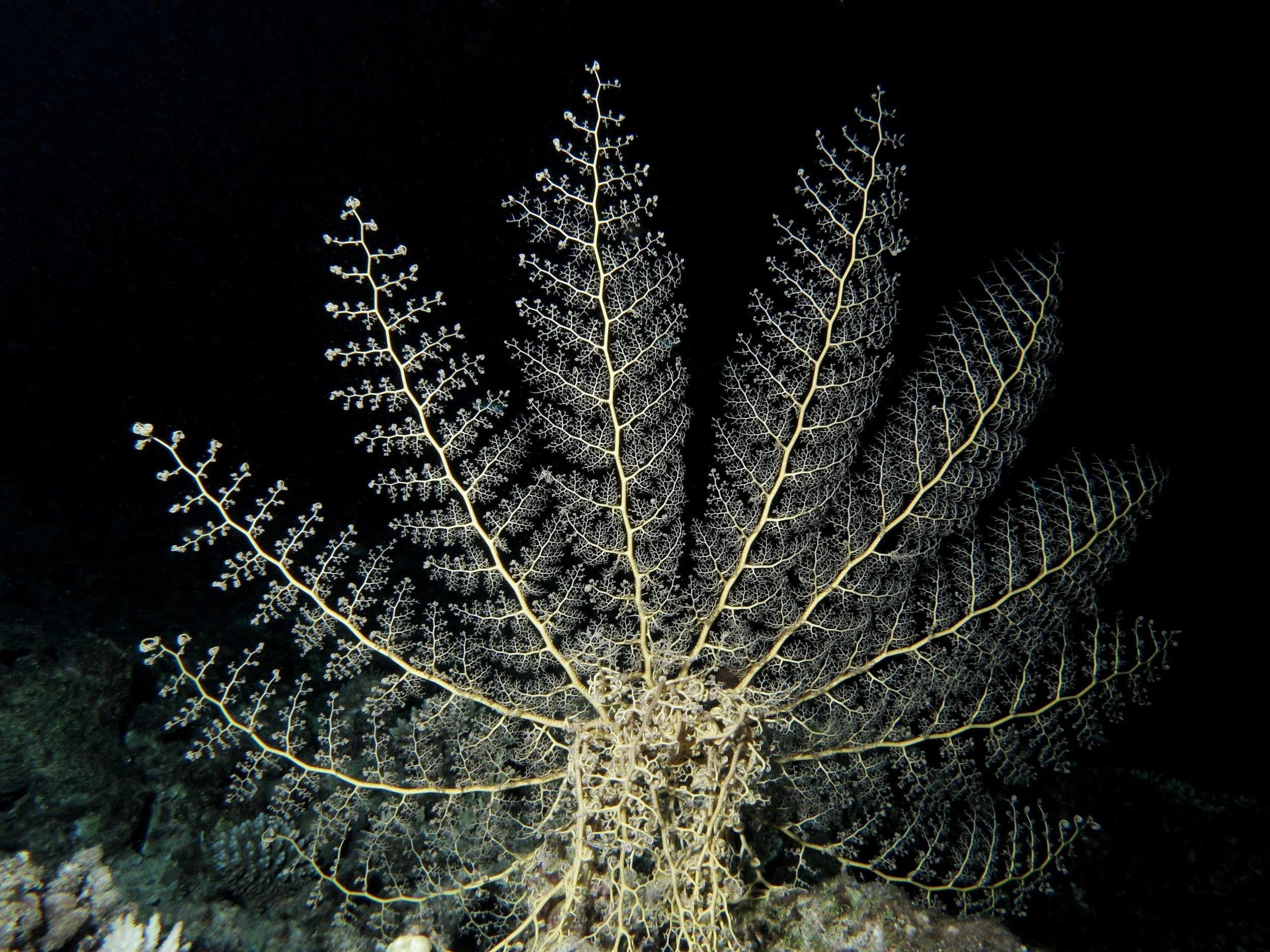
Basket star. Photo by Alexander Vasenin
The dome of the basket star is a further reference to the way dogmatic influence extends and spreads within a collective. The basket star has no central brain, but it still manages to extend its tendrils equally in all directions to collect nutrition from the surrounding environment, thanks to the self-balancing physical principles of growth.
The suppliants at the bottom of the column are displaying indicators of deference (deflated mantle, white/pale skin) and also wearing the restrictive headdresses assigned to male Octopolitans.
I guess this card is a little more ‘editorial’ than some of my previous ones! Can you tell I grew up in a church?
Artistic Process
This drawing took a very long time, and I struggled to keep it as simple as the others. I debated whether I should include all eight members, and I'm grateful to to Kassandra Cruz for helping me figure out the layout of the very complex physical space I had in mind for the Quidnunc’s chamber. Ultimately I'm very happy with the overall shape of the card, I do wish that I were experienced enough to simplify the drawing to use fewer gradients and blending layers. At small sizes I think the shapes will be hard to make out, and so I may re-draw this for print at card size, if I have time.